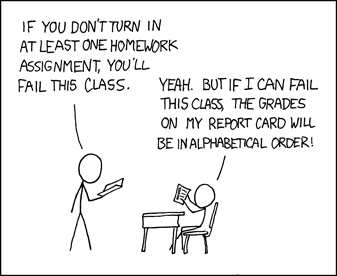
via XKCD
Great discussion between two of the biggest VC guys in the world, John Doerr (Kliener Perkins) and Fred Wilson (Union Square) about the nature of Web 2.0 and whether you need to be in silicon valley any more to build great tech. 38 minutes and worth it.
A very interesting look at how luck and skill interact and which of these dominates in different activities.
Untangling Skill and Luck: How to Think About Outcomes—Past, Present, and Future [PDF]
Fortuna, by Albrecht Dürer
Legg Mason, July 15, 2010

The illusion of control also comes into play here. This illusion says that when we perceive ourselves to be in control of a situation, we deem our probabilities of success to be higher than what chance dictates. Saying it differently, when we are in control we think our ratio of skill to luck is higher than it really is. Remarkably, this illusion even holds for activities that are all chance. For example, some people throw dice hard when they want a high number, and gently when they seek a small one. Like the belief in small numbers, this illusion is not a problem in high skill, low luck activities but becomes more problematic as the contribution of luck grows. Here again, our minds are poor at differentiating between activities, so what works in one setting fails miserably in another.
• Helps you share feedback properly. The best way to ensure satisfactory long-term results is to constantly improve skill, which often means enhancing a process. Gaining skill requires deliberate practice, which has a very specific meaning: it includes actions designed to improve performance, has repeatable tasks, incorporates high-quality feedback, and is not much fun. Deliberate practice works well in domains that are dominated by skill—learning to play the cello, for instance.
The challenge is providing good feedback. The reason is that the outcome is the only quantity you can measure with any reliability, but it doesn’t easily reveal the contribution of luck. The natural default for most of us—whether it’s a manager evaluating the performance of a direct report or an investor sizing up how a money-manager has done—is to rely on outcomes because that is something we can measure. What we can measure in the short term, however, may not be what matters in the long term. Ultimately, it is a good process that leads to satisfactory outcomes, but the quality of the process gets swamped in the short term by luck.